
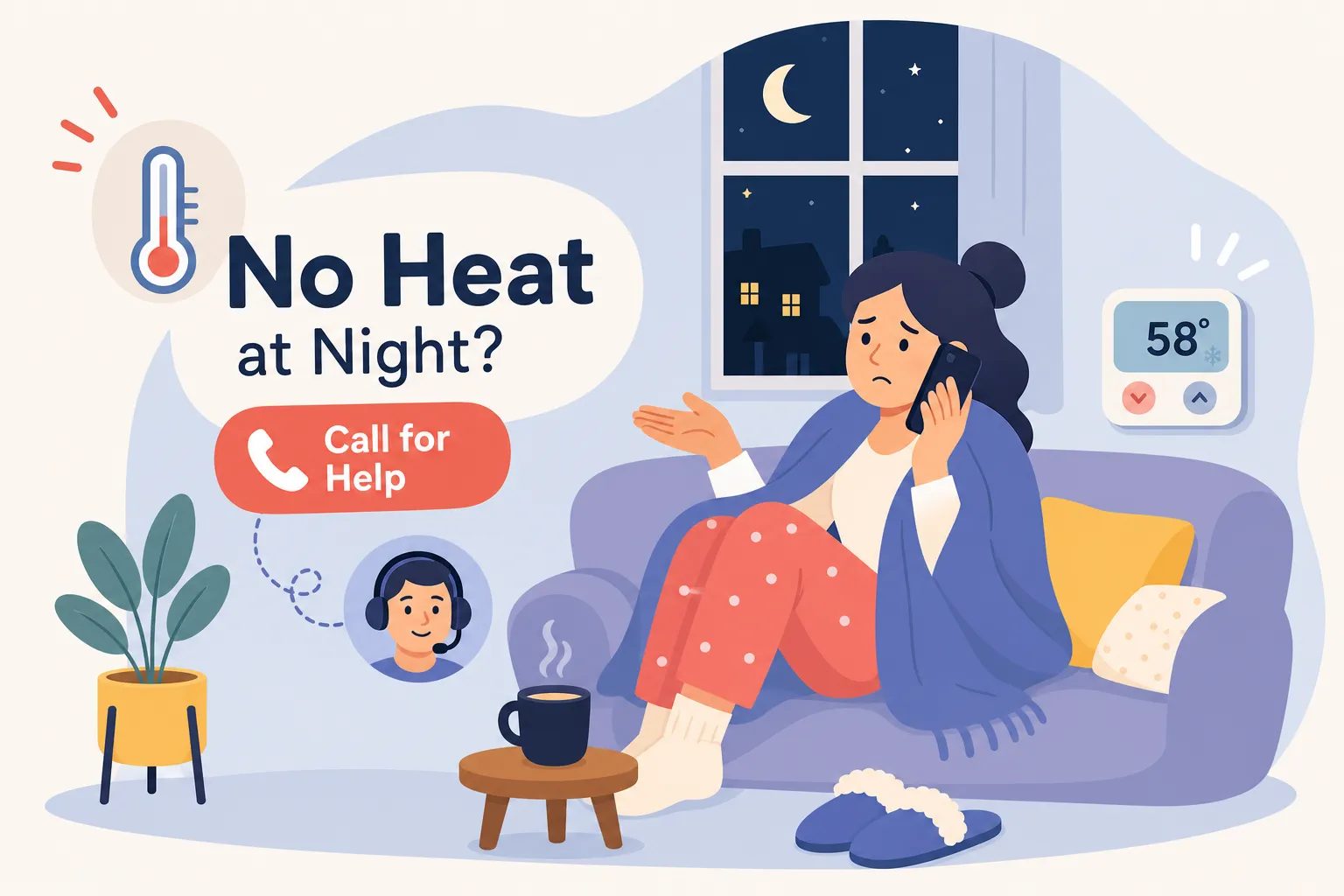
It's 11 p.m. The house is getting cold. You walked past the thermostat, noticed it reading 58 degrees, and realized the furnace isn't running. That tight feeling in your chest is completely normal, but stop right there. This is almost always a solvable problem. Most no-heat calls trace back to a thermostat, power, or fuel issue that homeowners can check in minutes. The key is following the right steps in the right order, starting with the safest ones first.
So who do you call when your heat stops working at night? The answer depends on two things: what type of heating system you have and whether there's an immediate safety concern in the home. Those two factors change everything. For Long Island homeowners running oil heat, Domino Fuel answers its emergency line 24/7 at (631) 779-3196. But before you dial anyone, a two-minute scan of your home might solve this without a service call at all. Here's the fastest path from no heat to heat restored.
Do the two-minute scan before you call anyone
These steps require no tools, no technical knowledge, and almost no light. Run through them in order before picking up the phone, because a surprising number of after-hours "emergencies" turn out to be a dead thermostat battery or a flipped breaker.
Safe things to check right now
Start at the thermostat. Confirm it's set to Heat (not Cool or Fan Only), raise the setpoint at least five degrees above the current room temperature, and check whether the display looks dim or blank. Dead batteries are one of the most common no-heat calls dispatchers receive, and swapping them takes thirty seconds.
Next, find the furnace's power switch. It often looks exactly like a standard light switch and is mounted on a wall near the unit, and it gets accidentally switched off more than you'd think. After that, head to your electrical panel and look for any breaker sitting in the middle position or clearly flipped to off. Move it fully to off first, then back to on. That one reset is fine. If it trips again immediately, leave it alone and call a technician.
Finally, if your home runs on heating oil, check the tank gauge. If the needle is sitting at or near empty, you've likely run out of fuel, and that's a delivery call, not a repair call. Keep in mind that tank gauges can stick, so if the gauge reads higher but the burner keeps locking out, tell the dispatcher the gauge reading and let them decide whether to send a truck or a technician.
When to stop troubleshooting immediately
Three signals mean you stop everything and skip ahead to the safety section below. If you smell gas anywhere in the home, hear a CO alarm sounding, or see smoke or sparks near any part of the heating system, do not touch any switches, do not keep troubleshooting, and do not assume it will clear on its own. These are not DIY moments under any circumstances.
Match the call to your heating system
There's no single emergency number that works for every home. The right contact changes based on whether your system burns oil, burns gas, runs on electric baseboard, or uses a heat pump. Calling the wrong type of company wastes time you don't have on a cold night, so identify your system first, then dial.
Oil-heated homes on Long Island: start here
Long Island has one of the highest concentrations of oil-heated homes in the country, and the most common after-hours failures in these homes fall into two categories: the tank ran dry, or the burner locked out. Both are resolvable with one call to an oil-heat specialist.
For oil heat, you want a fuel supplier with a verified 24/7 emergency line, one where a real dispatcher answers at 2 a.m. in January rather than a voicemail. If the tank needs a fill, they dispatch a delivery truck. If the burner is locking out because of a clogged nozzle, a failed ignitor, or a fouled cad cell (all common in older Long Island homes), you need a technician who works on oil burners specifically. Not every general HVAC contractor is familiar with burner controls, fuel lines, or oil-specific lockout sequences, so confirm a company's oil-heat experience before you call.
Domino Fuel offers 24/7 emergency oil delivery on Long Island and after-hours heating repair. For oil-heat customers in Nassau and Suffolk, it's a logical first call: (631) 779-3196.
Gas, electric, and heat pump emergencies
If your home uses natural gas and there's no smell of gas or other safety concern, your first call is to your HVAC service provider's after-hours line. If the issue appears to be supply-related, call your gas utility's non-emergency line instead. For electric baseboard or heat pump failures, a licensed HVAC technician is the right call. Heat pumps in particular can stop heating on very cold nights because of ice buildup on the outdoor unit or a defrost cycle issue, and those diagnoses require a technician, not a reset.
When 911 or the gas company emergency line must come first
Some situations skip every troubleshooting step entirely. When a safety trigger is present, the sequence is non-negotiable.
Gas smell or CO alarm: leave first, call after
If you smell gas or a carbon monoxide alarm is sounding, get everyone out, people and pets included, right now. Call 911 from outside or from a neighbor's home, then call your gas utility's emergency line. On Long Island, that's National Grid's gas emergency line at 1-800-490-0045, staffed 24 hours a day. Do not re-enter the building until emergency personnel have cleared it.
Carbon monoxide symptoms deserve a specific mention here because they're easy to dismiss. Headache, nausea, and confusion feel a lot like a stomach bug or exhaustion. If more than one person in the house feels "off" on a night when the heat is acting strangely, treat it as a CO situation until proven otherwise.
Power outage vs. heating system failure
Before you call an HVAC technician, look out the window. If the neighbors' homes are dark, the streetlights are out, or your entire home lost power, you're dealing with a utility outage, not a heating system failure. In that case, call PSEG Long Island's outage line. No HVAC technician can help until the utility restores service, and skipping this check leads to an unnecessary service fee and a technician who can't do anything useful.
What to have ready before you dial
A 60-second prep before you call makes every emergency dispatch faster. Technicians and dispatchers ask the same questions on every call, and having the answers ready cuts the call short and gets a truck moving sooner.
System details and account information
Gather your home address, the type and brand of your heating system, and the approximate age of the unit if you know it. For oil-heated homes, note what the tank gauge reads right now. Have your account number with your fuel supplier on hand. It lets dispatch pull up your tank size and delivery history immediately instead of asking you to guess. If you don't know your account number, your most recent invoice will have it.
What to say when they answer
Open by stating that it's an after-hours heating emergency. Confirm immediately whether there's a gas smell or CO alarm, or clearly state there isn't, so the dispatcher can route the call correctly. Then describe the symptom as precisely as you can. "The furnace cycles on but blows cold air" is far more useful than "the heat isn't working." Finally, mention how many people are in the home and flag any elderly residents, young children, or medical conditions that make the cold especially dangerous. Dispatchers use that information to prioritize calls during busy nights.
If you're renting, your emergency path is different
Renters have a separate chain of contacts and a set of legal protections that change the sequence entirely. In most cases you're not calling an HVAC company first. You're calling your landlord, and the law backs you up on that.
Your landlord's legal obligation when heat fails
In New York, heat is part of the warranty of habitability that every residential lease carries, whether or not it's written in. For multiple dwellings outside New York City, state law requires landlords to maintain at least 68°F during the day when it's below 55°F outside, and at least 55°F overnight when it's below 40°F outside. Many Long Island towns and villages have their own housing codes on top of that.
Your first call is your landlord or property manager's emergency contact. Send a text or email immediately after that call so you have a documented timestamp. That documentation matters if you need to escalate.
One Long Island wrinkle: many rentals here are single-family homes where the tenant buys their own heating oil. If that's your arrangement and the tank is empty, the delivery is on you, and you can call Domino Fuel directly for an emergency fill. If the burner itself has failed, that's still the landlord's responsibility.
If the landlord doesn't respond within a few hours
If you haven't heard back within a few hours of a nighttime no-heat emergency, escalate. Response requirements vary by municipality and often give landlords 24 to 72 hours, but a documented call to code enforcement puts the clock on record. On Long Island, housing codes are enforced at the town and village level, so contact the building department or code enforcement office for your town (Hempstead, Oyster Bay, North Hempstead, Babylon, Islip, Brookhaven, and so on) or your incorporated village. Most have a non-emergency number that takes complaints after hours, and a heat complaint can trigger an inspection.
While you're waiting, close off any rooms you're not using so warmth stays in the spaces where people are sleeping, layer up, and if you have a safe electric space heater, use it in the room where you're gathered. Never use a gas oven, a charcoal grill, or any unvented propane heater indoors as a heat source, even temporarily.
What to realistically expect after you call
Knowing what's coming helps you stay calm while you wait. After-hours heating calls don't always mean someone's at your door in 30 minutes, but you're rarely looking at a full night without resolution.
Response time windows for after-hours heating calls
On Long Island, residential emergency HVAC response typically runs one to three hours on a normal winter night. Severe cold snaps can stretch that window when many systems fail at once. Local providers with technicians and trucks already on the island can usually respond faster than calls routed through a national HVAC chain. For after-hours call-out fees in the New York metro area, expect a range of roughly $200 to $400 for the dispatch itself before any parts or labor, with fees at the higher end during holiday periods or extreme weather.
How to stay safe and warm while you wait
A well-insulated home in a northeastern winter loses heat slowly. At outdoor temperatures around 20 to 30 degrees Fahrenheit, a properly insulated home typically takes six to twelve hours to drop to a genuinely uncomfortable temperature, which gives you a real window to work with. Close off unused rooms and keep interior doors shut so body heat concentrates where people are gathered. Add layers, pile on blankets, and let everyone sleep in the same room if it gets cold enough to warrant it. You've already done the right things by placing the right call. The heat will be back on.
The short version
No heat at night means running through a short sequence, not panicking. Do the two-minute scan first: thermostat settings, furnace power switch, circuit breaker, oil gauge. If there's a gas smell or CO alarm, get out and call 911, then National Grid at 1-800-490-0045. If you're on oil heat on Long Island and need after-hours repair or a delivery, call Domino Fuel at (631) 779-3196, any hour, any day. If you rent, call your landlord first and document it in writing. Have your account info and a clear symptom description ready before you dial any service provider.
For Long Island homeowners, the most important thing you can do before next winter is save your fuel supplier's emergency number in your phone right now. Finding a trusted local supplier with 24/7 emergency coverage is not a task you want to tackle at midnight with a cold house. Getting that contact saved today means one less thing to figure out when it matters most.
Frequently asked questions
Who do I call if my heat stops working in the middle of the night on Long Island?
If you smell gas or a CO alarm is sounding, leave the house and call 911, then National Grid at 1-800-490-0045. Otherwise, call the company that services your heating system. For oil heat, Domino Fuel's emergency line at (631) 779-3196 is answered 24/7 for both deliveries and burner repairs.
Is no heat at night considered an emergency?
Yes, especially when outdoor temperatures are below freezing or when infants, elderly residents, or people with medical conditions are in the home. Most fuel suppliers and HVAC companies treat a total loss of heat as a priority call and dispatch the same night.
What does an after-hours heating repair cost?
In the New York metro area, the emergency dispatch fee alone typically runs $200 to $400, with parts and labor on top. Fees tend to be higher on holidays and during extreme cold. If the problem is simply an empty oil tank, you pay for the fuel and, in some cases, a burner prime and restart.
How long can my house go without heat before pipes freeze?
A properly insulated home at outdoor temperatures in the 20s usually stays above freezing indoors for well over 12 hours. Pipes in exterior walls, crawl spaces, or unheated basements are at risk sooner. If the house is dropping fast, open cabinet doors under sinks and let faucets drip slowly while you wait for service.