
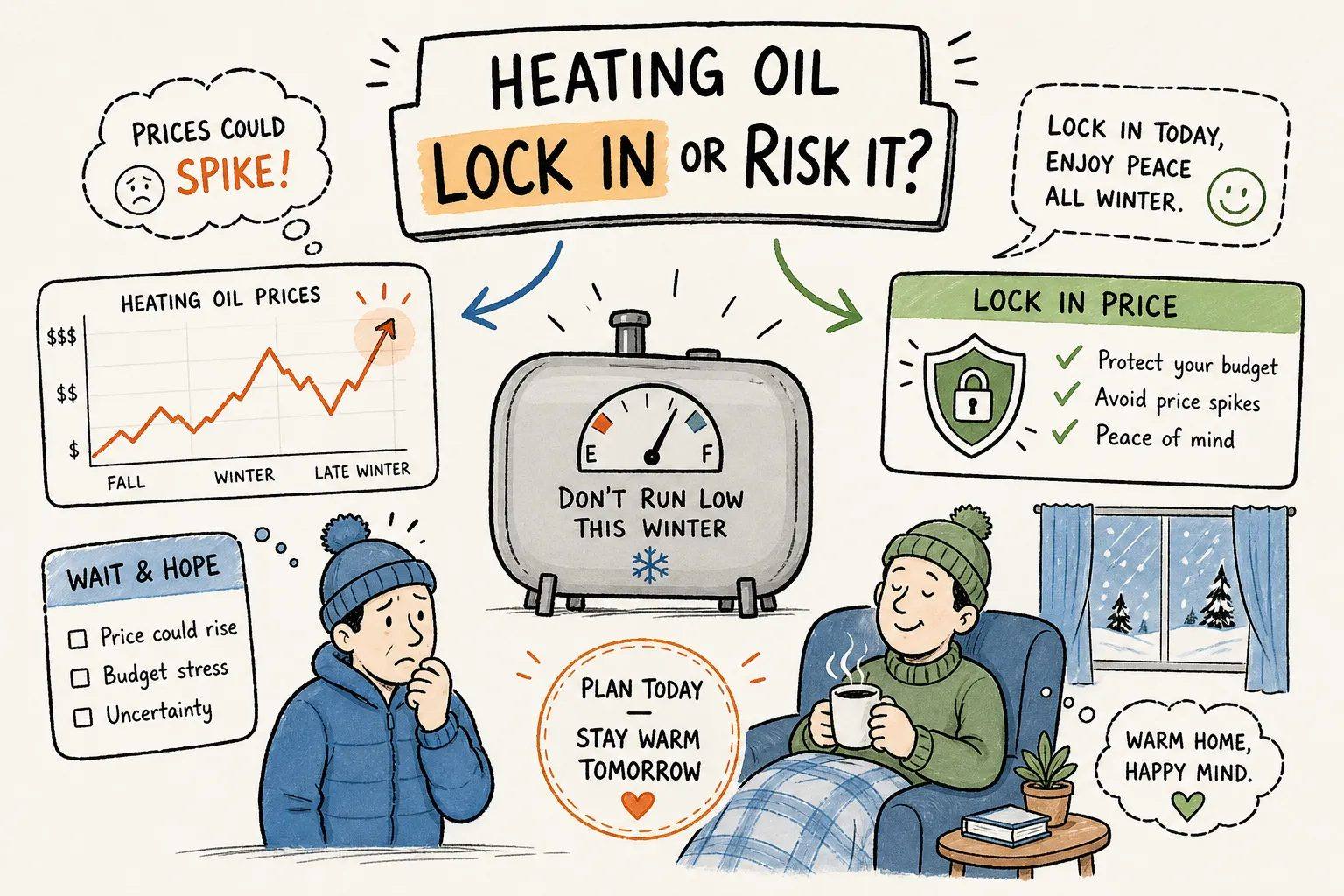
Every August and September, full-service oil dealers on Long Island start calling customers about locking in a price for the winter. The pitch sounds simple: pay a set rate now and stop worrying about January. The reality is more complicated. A locked price is insurance, and like any insurance it has a premium, fine print, and situations where it pays off and situations where it does not.
Domino Fuel does not sell locked-in prices or contracts. We sell discount COD heating oil at a price that is posted daily and backed by a Low Price Guarantee. This guide explains how lock-in plans actually work so you can judge any offer on its merits, then shows how most Long Island homes get the benefits people want from a lock, predictability and protection from spikes, without signing anything.
What "locking in" your heating oil price actually means
Dealers use different names, but there are four structures behind almost every offer.
Fixed-price contracts
You agree to one per-gallon price for the season, usually for a set number of gallons. If the market rises, you keep paying the locked rate. If the market falls, you also keep paying the locked rate. The dealer hedges its own risk on the futures market, and that hedging cost is built into the price you are quoted, which is why a fixed rate is often set above the day's cash price at signing.
Price cap plans
A cap sets a ceiling. If the market climbs above it, you pay the cap. If the market drops below it, you pay the lower price. Because the dealer takes on the downside without the upside, caps carry a per-gallon premium or an enrollment fee, or both. It is the most flexible of the contract options and also the most expensive to buy into.
Prebuy plans
You pay for a block of gallons before the season starts, typically at a discount for paying early. It behaves like a fixed-price contract, but the money leaves your account in August. If the dealer runs into trouble over the winter, your prepaid gallons are only as safe as the company holding the money.
Budget plans
A budget plan spreads your estimated annual oil cost across equal monthly payments. It does not protect you from price changes on its own. It is a cash-flow tool, and dealers often layer it on top of a fixed or cap plan. When someone pitches a budget plan, ask whether the price is also fixed, because those are two separate questions.
Why Long Island heating oil prices rise from fall into winter
Heating oil is refined from crude, so it follows the global crude market first. On top of that, Long Island demand falls to almost nothing from May through September and builds fast once October arrives. Low demand means suppliers compete for every gallon, which is why summer prices on Long Island typically run 10 to 20 percent below peak-winter rates. A cold snap, a refinery outage, or a supply squeeze in the Northeast can push prices up quickly in the middle of the season. That mid-winter uncertainty is the entire selling point of a lock.
The real trade-offs of a locked price
What you gain
You know your per-gallon cost for the season, so a cold January cannot surprise your budget. On a cap plan, you also keep some of the benefit if prices fall.
What you give up
You pay a premium for certainty whether or not you end up needing it. On a 700-gallon winter, a lock set 30 cents above where the market settles costs you about $210 for protection you did not use. You are also tied to one dealer for the season. If service disappoints or a better price appears down the road, most contracts charge an exit fee or hold you to a minimum purchase.
Two winters, same contract
Say you lock in at $3.80 for 700 gallons. If the market averages $4.30 through the season, you saved about $350. If it averages $3.40, you overpaid by about $280. Nobody knows in August which winter is coming. The decision is not about forecasting the market. It is about how much price movement your household can absorb.
Who a lock-in plan genuinely suits
A fixed or cap plan makes sense for a household on a fixed income where a $150 jump in a monthly bill is a real hardship, for large or poorly insulated homes burning 1,000 gallons or more, and for anyone who simply does not want to think about oil prices between October and April. If that is you, a contract can be worth the premium.
For most Long Island homes, the math points the other way. A well-insulated house burning 600 to 800 gallons has limited exposure, and the premium on a lock often eats most of the protection it provides. You can capture most of the upside of a lock with a few habits and no contract.
What to read before you sign any heating oil contract
If you are considering a lock with another dealer, the contract matters more than the pitch. The New York Department of State's Division of Consumer Protection publishes heating oil contract tips that cover the same points.
- Gallons covered. Confirm how many gallons are at the locked price and what you pay if you use more. Overage is usually billed at the market rate, which is highest exactly when you need the extra oil.
- Premiums and fees. Ask how the cap premium or enrollment fee is calculated and whether it is refundable.
- Cancellation. Find the exit fee and the notice period. Some contracts hold you to a minimum purchase even if you move.
- Automatic renewal. Many plans roll into next season unless you cancel in writing by a specific date.
- Prepay protection. For a prebuy, ask what secures your money if the dealer cannot deliver.
How to get the benefits of a lock without a contract
Domino Fuel customers do not sign anything. Here is how they keep their winter oil costs predictable anyway.
Fill in the off-season
Ordering between May and September puts your first tank of the winter in at the lowest prices of the year. Check today's discount COD price any day. It is posted every morning, and there is no premium built in because there is no hedge to pay for.
Buy on the dips, not on a schedule
Because COD means you order when you want, you can top off when the daily price drops instead of taking whatever the market does on a fixed delivery date. Our 25-gallon minimum, one of the lowest on Long Island, means you can take a partial fill on a good day rather than waiting until the tank is empty.
Let automatic delivery handle the timing
If you would rather not watch prices, automatic delivery tracks your usage against the weather and fills the tank before you run low. There is still no long-term contract, and you still pay the day's discount price on each delivery.
Cut the gallons, not just the price
The cheapest gallon is the one you do not burn. An annual burner tune-up keeps your system running efficiently, and if your boiler or furnace is more than 15 years old, a high-efficiency replacement lowers your exposure to every winter's prices, not just this one.
Keep an emergency option
A lock-in protects your price but not your heat. Domino Fuel runs same-day delivery on orders placed before 10 a.m., Sunday deliveries, and 24/7 emergency service across Nassau, Suffolk, and Queens, so running low in a cold snap is a phone call, not a crisis. Call (631) 779-3196.
The short version
Locking in a heating oil price is insurance with a premium attached. It suits fixed-income households, very large oil users, and anyone who wants zero price exposure and accepts the cost. For most Long Island homes, buying discount COD oil, filling in the off-season, topping off on price dips, and keeping the burner tuned delivers most of the same protection with no contract, no exit fee, and no premium. Domino Fuel posts its price daily, backs it with a Low Price Guarantee, and never asks you to sign.
Frequently asked questions
Does Domino Fuel offer fixed-price or price-cap plans?
No. Domino Fuel sells discount COD heating oil at a daily posted price with no contracts. Automatic delivery is available for customers who want the tank managed for them, also without a long-term contract.
Is it cheaper to lock in heating oil or buy COD on Long Island?
Over most winters, COD comes out ahead because a lock includes a hedging premium and COD does not. A lock wins only in a winter where prices spike well above the locked rate. Buying COD in the off-season and topping off on dips captures most of the difference.
When is the best time to fill my oil tank on Long Island?
May through September, when demand is lowest and prices typically run 10 to 20 percent below peak-winter rates. A second top-off in early fall, before October demand builds, is a good habit.
Can I get out of a heating oil contract with another company?
Usually, but read the cancellation clause first. Most fixed and cap contracts carry an exit fee, a minimum purchase, or a written-notice deadline. Once you are out, you can order COD oil from Domino Fuel with no sign-up and pay at delivery by cash, certified check, money order, or credit card.